

Sono Luminus
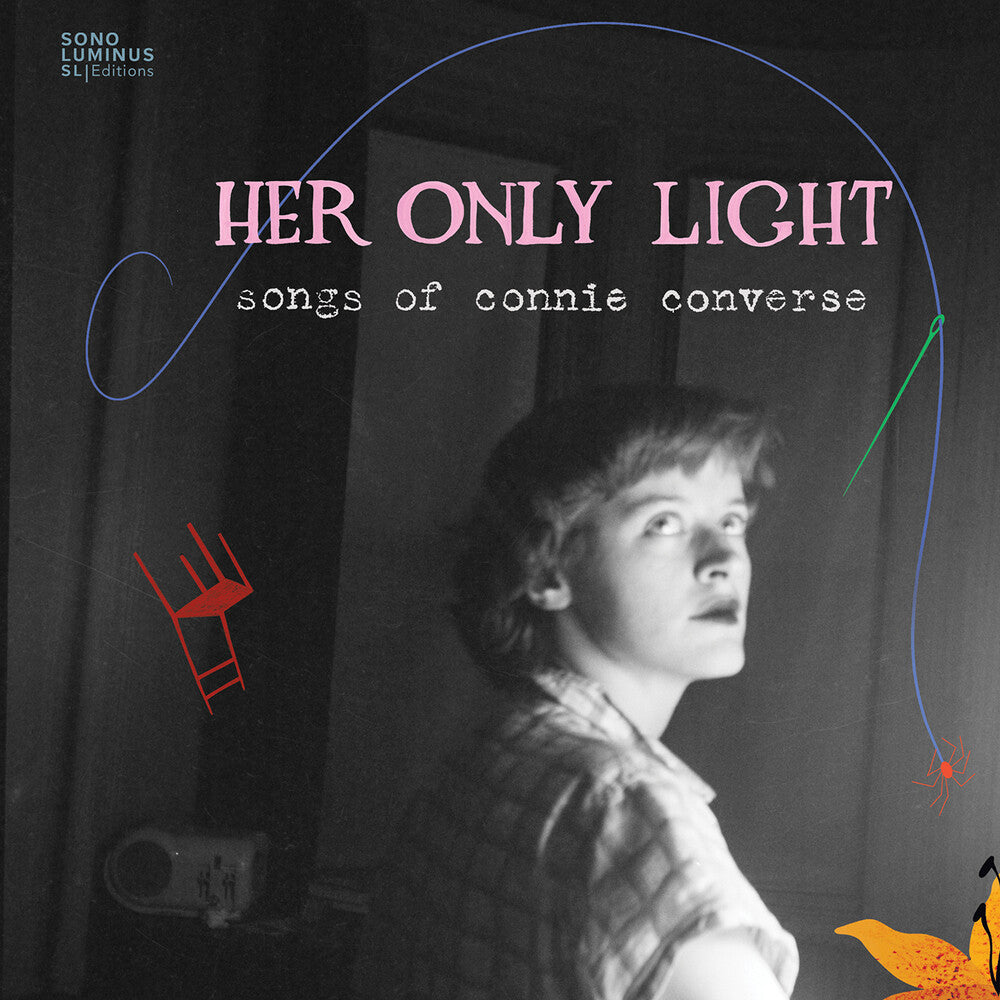
Pre-Order: Her Only Light - Songs Of Connie Converse [CD]
Pre-Order: Her Only Light - Songs Of Connie Converse [CD]
SKU:053479704900
Couldn't load pickup availability
Evelyn Converse (Connie's mother):Is it sweet little ditties or is it modernistic?Connie Converse:It's got everything in it.I'm the one in the smoky gray button-down, gently disentombing a viola from it's case in the gauzy, late morning light illuminating this inviting Northcenter studio. In the freelance Classical (and Classical-adjacent) world, projects and their attendant rehearsals encompass the vibes and caliber spectrum, but managing the contents of one's tear ducts is not generally a required qualification.Maybe you can try to get word to the violist, currently encamping himself and his stand beneath a towering harp. That unwitting sap-the one who at this moment only knows that the pieces he's playing were originally penned by someone with an enticingly alliterative moniker-has no idea that this music is about to occupy a good deal of the rent-free space available in his head and heart long after the live broadcast, the 'gig,' wraps.It is, I'm afraid, a decidedly common reaction to an oeuvre of unquestionably uncommon music for those that encounter it some seventy-plus years since it was meticulously penned. Whether this is your first orbit or you already count yourself amongst the members of the How Sad, How Lovely devout-Connie's modest and also astonishing kitchen table recordings, most recently reissued by her fellow Michiganders Third Man Records-the sounds currently spinning through your synapses here offer an entirely unique perspective of an artist who not only scooped Dylan on coaxing folk music from the universal to the personal by a literal decade, but indeed ventured into a territory of art song he will never quite access. Her Only Light is a more dimensional, more expansive view of Connie Converse, a composer-performer-pacifist-scholar-activist who, like the story of her enigmatic departure, deserves a telling beyond an easy headline.Some orientation is necessary, though. Elizabeth Eaton Converse was valedictorian of her high school, a scholarship recipient at Mount Holyoke College, a songwriting hopeful in Harlem, and the Co-Editor of the Journal of Conflict Resolution (Center for Research on Conflict Resolution) at the University of Michigan. Was she, as is editorialized about so many of my favorite creators, maybe a little too smart to be happy? A more accurate assessment arrives by way of her nephew Tim Converse, who generously shared with me, 'I think that she saw so clearly the way things should be that she was constantly disappointed by how things actually were.'This was certainly the case regarding her years in New York, having absconded early from Mount Holyoke to pursue her songwriting and singing aspirations. Consider that the 1950's Greenwich Village folk revival-in full swing as she composed-for all it's posturing about political revolution and working-class authenticity, was structurally about as progressive as a debutante ball. Add to that the fact the (then) recording industry's almost unshakable insistence on genre conformity and, in the case of female performers, sexual magnetism, and it doesn't take much to understand how a path-carving artist more engrossed in her compositional brilliance than her appearance failed to break through to the monoculture.Though history is of course littered with unrecognized genius, this was actually not precisely the case for Converse. She was featured on CBS's The Morning Show hosted by no less than Walter Cronkite, and was championed by animator Gene Dietch who, in addition to her own efforts, we have to thank for the recordings found on How Sad, How Lovely. At this inflection point, when she seemed poised to, well, make it, Connie Converse pivoted her writing toward a far less marketable but perhaps more adventurous corner of musicmaking: 'art song.' If Connie's 'Guitar Songs' (singer-songwriter, folk-oriented) were slow to gain traction, what hopes could her 'Piano Songs' (art song, harmonically enterprising) possibly have in such an inhospitable industry?Jesus. We're halfway through these liner notes and I haven't even introduced you to the two remarkable interpreters of said songs-the thoughtful Converse evangelists behind Her Only Light: arranger Ronnie Kuller and vocalist Emmy Bean. Almost immediately in that aforementioned rehearsal, which I should clarify was in service of a live performance on WFMT after this album was mixed and mastered, I was scheming how I might stay in proximity to Ronnie's dextrous, insightful writing and Emmy's lustrous, utterly persuasive phrasing in the years to come.Like so many generative collaborations, theirs originated in an abiding desire for connection and a fascination with the sublime. It was also a creative lifeboat in the not-so-distant era of prolonged home confinement. Sparked by Bean's sharing the 2015 Anna and Elizabeth cover of 'Father Neptune'-the harmonizing of which would provide inspiration for the arrangement here-with Kuller (who had already taken Converse's music up on stage while in residence at beloved Chicago venue The Hideout) the latter describes her decision-making process with unguarded enthusiasm:'I want a harp. I want two clarinets at the same time. I want a string section! I want Emmy Bean to sing to me!'Ronnie goes on to share what I consider an essential reason why Her Only Light is so riveting and unmissable: 'When Emmy is singing, I believe every word.' Given that Connie is often credited with originating the singer-songwriter genre, one in which vulnerability evaporates any dramatic or emotional partition between singer and lyric, Converse's songs can only truly thrive when delivered with such tender veracity.As the duo explored Converse's art songs, transcribed by Kuller from the hand-written original scores, the desire for immersion in and dispersion of these songs only deepened. Emmy describes her 'forever memory' like this:'Once we got started on the art songs we began with 'Song for Old Wars,' and I remember singing it for the first time in a big cavernous room on an old piano. This was a few weeks after Russia invaded Ukraine in 2022. Hearing the final cadence of that song echo in the room-the ""horns""-was incredible. It gave me something to honor in all the chaos of new/old wars; I felt like Connie was with us, grieving the losses.'The other partition in need of a wrecking ball-one of primary importance to both singer and arranger-was that of folk song vs. Art song. Not only is this boundary a fanciful one perpetrated by hierarchically-minded (i.e. misled or confused) listeners and record industry execs originating from preconceptions about formal education, 'rigor,' and, to get right down to it, vibratoin the context of Connie Converse it results from the reality that her art songs, the 'Piano Songs,' never made it on tape during her own and Dietch's kitchen recording sessions. They were written later, and composed for voices other than her own, sometimes soprano, sometimes baritone. Emmy found herself slipping into Connie's world without friction, but decisions on how to stylistically inhabit the 'Guitar' and 'Piano' songs only revealed itself once the project was at full tilt:'I was surprised to find how Connie's songs invite another singer into them. Some songs belong so intimately to their writer's voice (especially folk singers or singer-songwriters) that it feels wrong to sing them or hear them sung by others. When I took on this project, I was afraid that I wouldn't be able to find the access point, that I wouldn't be able to inhabit them, that I would find myself mimicking her or struggling to find myself in them. But the craft that Connie put into her art songs-the 'Cassandra Cycle,' 'anyone lived in a pretty how town,' etc-is also there in the songs she wrote on guitar. They are no less solid, no less fully realized than the ones she wrote on piano. They completely stand on their own, and they welcome any s
UPC: 053479704900
Label: Sono Luminus
Release Date: 10.2.26
Format: CD
Share
![Pre-Order: Her Only Light - Songs Of Connie Converse [CD]](http://sunshinedaydream.store/cdn/shop/files/4529822-3673833.jpg?v=1784917580&width=300)